Portable Fan Rattles: Guard, Dust, Base and Blade Checks
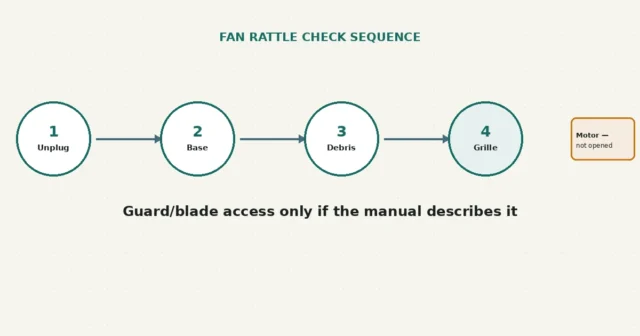
A rattle may relate to accessible dust, grille fit or base contact, but sound alone cannot identify the motor condition.…

White dust settling near a humidifier is commonly associated with minerals in the water being dispersed into the air, according to EPA guidance — but the dust itself doesn’t confirm that on its own, since dried humidifier residue and household dust can look similar. Which humidifier type you have, and what’s in your water, both shape what your options are.
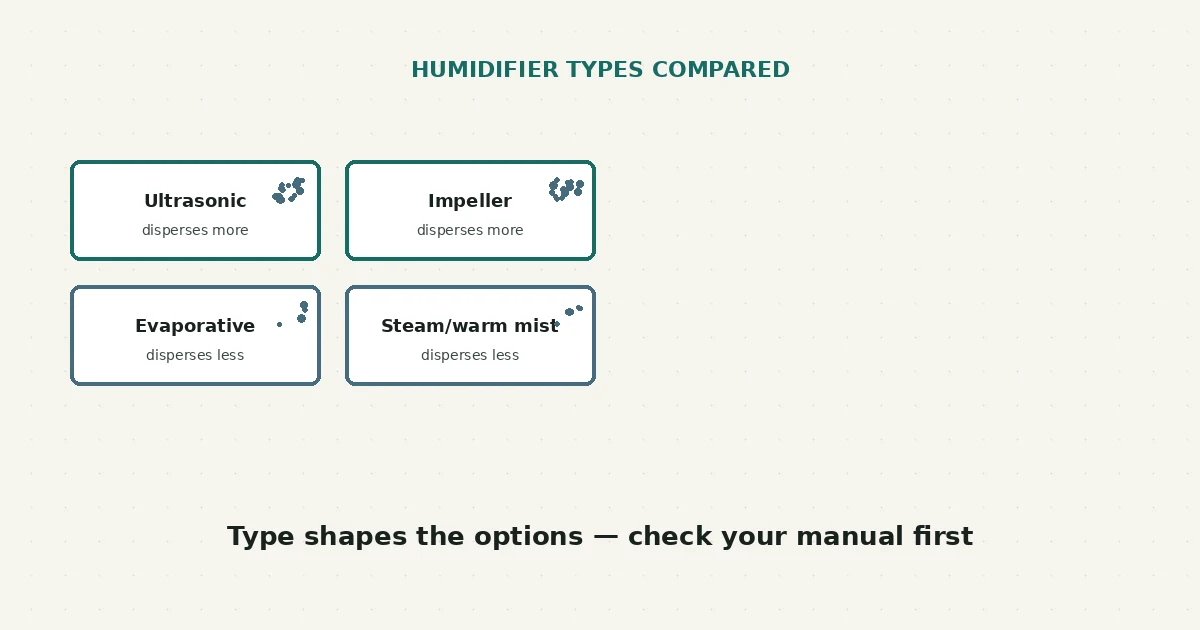
Ultrasonic and impeller (“cool mist”) humidifiers are the types EPA guidance associates most with dispersing minerals from water into the air. Evaporative and steam vaporizer (“warm mist”) humidifiers are not expected to disperse substantial amounts of minerals. If you have an ultrasonic or impeller model and see white dust, using water with lower mineral content, or a manual-compatible demineralization cartridge if your model has one, are the options EPA guidance points to — neither is guaranteed to eliminate it completely.
EPA’s guidance on home humidifiers groups portable humidifiers into a few broad categories, and it’s worth being clear this is a general framework, not a guarantee about how any specific model performs:
| Type | How it works | Mineral dispersal, per EPA guidance |
|---|---|---|
| Ultrasonic | Creates a cool mist using high-frequency vibration | Among the types associated with dispersing more minerals and microorganisms |
| Impeller (“cool mist”) | Creates a cool mist using a high-speed spinning disk | Among the types associated with dispersing more minerals and microorganisms |
| Evaporative | A fan blows air through a moistened wick, belt, or filter | Not expected to disperse substantial amounts of minerals |
| Steam vaporizer / “warm mist” | Heats water electrically to create steam, sometimes cooled before release | Not expected to disperse substantial amounts of minerals |
These are broad categories, not a guarantee about how any specific model performs — two ultrasonic humidifiers from different manufacturers, or even different models from the same manufacturer, aren’t necessarily identical in design. Your model’s manual is the most reliable source for how your specific unit is built and what it supports.
| What you observe | Possible explanation | Reasonable next step |
|---|---|---|
| Fine white film settling near an ultrasonic or impeller humidifier during use | Consistent with mineral dispersal from tap water, per EPA guidance | Consider lower-mineral water or a manual-supported cartridge |
| White dust despite already using distilled water | Distilled water still contains some minerals; effectiveness varies | Recheck water source and cartridge condition, if applicable |
| No white dust, but a musty smell from the tank | Different issue — points toward cleaning frequency rather than mineral content | Follow your manual’s cleaning schedule and drying guidance |
| Dust on an evaporative or steam-vaporizer model | Less expected for these types per EPA guidance; worth checking the source isn’t unrelated household dust | Confirm the humidifier is actually the source before changing your routine |
These patterns are a starting point for your own observation, not a lab-confirmed diagnosis of what’s in your air or on your surfaces.
This guide covers the tank, exterior surfaces, and manual-identified removable parts such as wicks, filters, and demineralization cartridges. It does not cover opening the base, motor, ultrasonic transducer, heating assembly, or any wiring, and it does not make claims about specific health outcomes. EPA guidance notes that if you have respiratory symptoms you believe are associated with humidifier use, even while following maintenance directions, stopping use and contacting a physician is a reasonable step — that’s a medical question outside this guide’s scope.
This guide doesn’t make that claim, and you shouldn’t assume it from marketing language either — a humidifier adds moisture to the air, which is a comfort function; broader health effects are a separate question EPA guidance treats with caution.
No — distilled water contains lower mineral content than most tap water, which typically reduces white dust, but EPA guidance doesn’t describe it as a complete guarantee for every situation.
The federal government has not concluded that using tap water in ultrasonic or impeller humidifiers poses a serious health risk, per EPA guidance, though it does note the minerals dispersed and encourages lower-mineral water as a precaution for those who wish to reduce exposure.
This depends entirely on your model and your water — check your manual’s guidance, and watch for white dust returning as a sign a cartridge may need replacing sooner than a fixed schedule would suggest.
That’s a reasonable option to weigh, but it’s a personal decision rather than something this guide recommends outright — evaporative models generally disperse less mineral content per EPA guidance, but they also work differently day to day, including needing a wick or filter changed on its own schedule. Compare what matters most to you against your current unit’s manual before deciding.
If you’re also managing humidity with a dehumidifier elsewhere in the home, this guide to a dehumidifier that runs but collects no water covers a related set of conditions-based observations. And if an air purifier in the same room seems to be moving less air than it used to, this air purifier airflow guide uses a similar manual-first approach.
New to RFSE? See how to approach any RFSE guide safely, or browse the full Air & Comfort hub for more guides like this one.
This guide is based on official EPA guidance and manufacturer documentation current as of publication. Humidifier design, water requirements, and filter compatibility vary by model — always confirm details against your exact unit’s manual.
A rattle may relate to accessible dust, grille fit or base contact, but sound alone cannot identify the motor condition.…
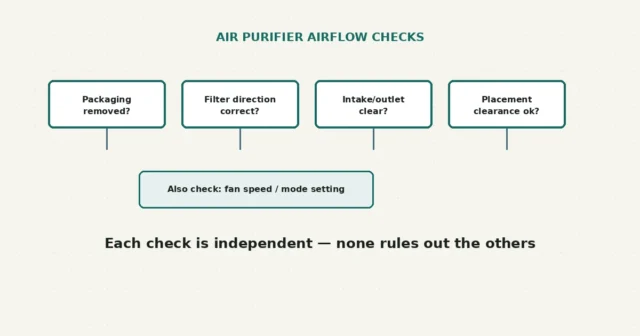
Check removable packaging, filter orientation, vent clearance and placement against the exact manual. Felt airflow does not prove filtration performance…
The accessible grille is one low-risk first check after the manual-required power isolation. A tissue test cannot measure airflow or…