Humidifier Leaves White Dust: Water Minerals, Filters and Options
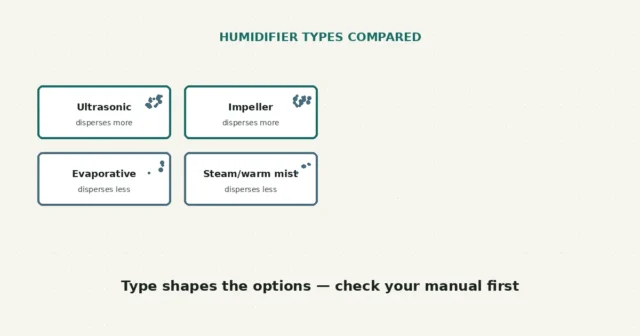
White dust is often associated with minerals dispersed by ultrasonic or impeller humidifiers, per EPA guidance, though appearance alone cannot…
A bathroom exhaust fan that feels weak is often, though not always, related to dust and buildup restricting the grille and the accessible cover — a genuine user-level check. Anything beyond the grille and cover, including the fixed wiring, switches, ductwork, and roof or attic terminations, is outside what this guide covers and calls for a qualified professional.
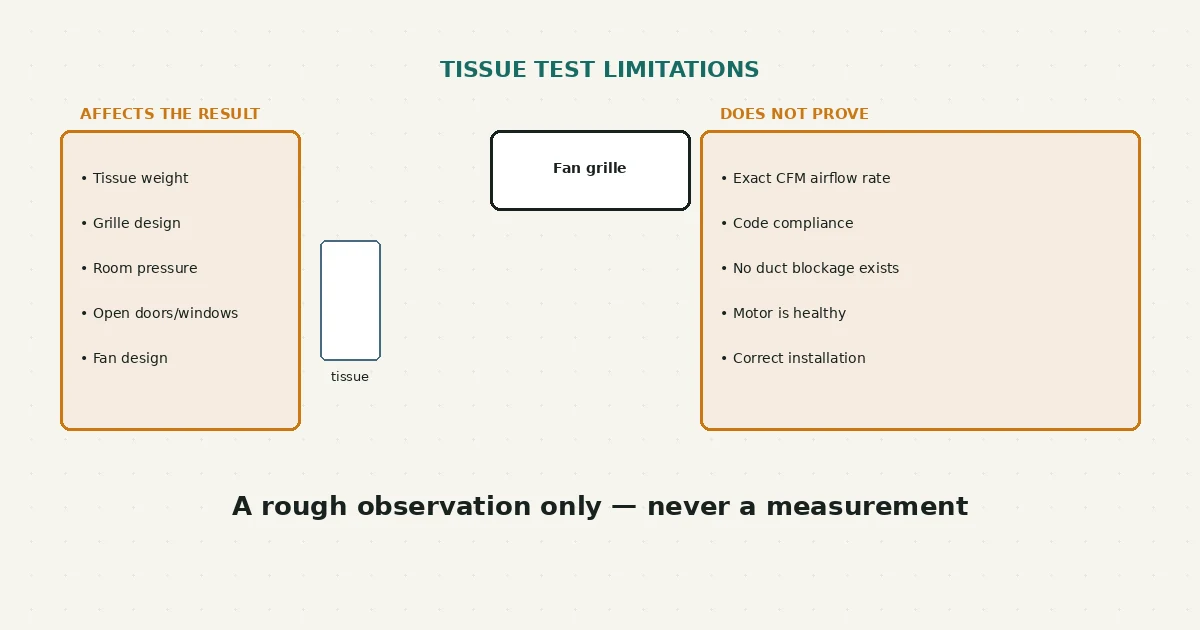
Switch off power to the fan the way your manual requires before touching it. Check whether the grille or cover is visibly dusty and whether your exact manual allows you to remove and clean it. A tissue held near a running fan can give a rough sense of airflow, but it’s not a measurement — weak tissue movement alone doesn’t confirm a specific cause. If cleaning the accessible cover doesn’t help, or if you can’t safely reach and clean it, that’s a reasonable point to contact a professional.
Bathroom exhaust fans have two very different zones: the grille or cover you can see and, on many models, remove for cleaning, and everything behind it — the motor, the housing, the wiring, the switch, and the duct running to the outside. This guide only covers the first zone, and only when your exact manual describes a safe way to access it without electrical disassembly.
Fixed wiring, switches, timers, junction boxes, motor replacement, duct disassembly, roof work, and attic or crawlspace access are all outside this guide’s scope. If addressing weak airflow requires any of those, that’s a job for a qualified electrician or HVAC professional, not a DIY step.
| What you observe | Possible explanation | Reasonable next step |
|---|---|---|
| Visible dust caked on the grille slots | Restricted airflow at the accessible cover | Clean the grille per your manual’s guidance, if it describes a safe method |
| Grille looks clean but airflow still feels weak | May involve the duct, damper, motor, or installation — all outside this guide’s scope | Contact a professional for further diagnosis |
| Airflow feels different with the bathroom door open vs. closed | Room pressure and available makeup air can affect how a fan performs | Note this as an observation; it doesn’t confirm a fault |
| Fan has never been cleaned since installation | Gradual buildup is common and easy to miss | Start with a routine cleaning of the accessible cover |
| Airflow was fine until a recent event (renovation, new furniture, closed vent elsewhere) | Something in the room or duct system may have changed | Consider what changed around that time as a clue, without assuming a specific cause |
These are patterns to help you decide whether a simple cleaning is worth trying or whether it’s time to call a professional — not a confirmed diagnosis of duct blockage, motor failure, or incorrect installation.
This guide covers room conditions, the accessible grille or cover, and visible dust reachable without electrical disassembly. It does not cover fixed wiring, switches, timers, junction boxes, motor replacement, duct disassembly, roof work, or attic or crawlspace access. It does not diagnose duct blockage, motor failure, or incorrect installation from hand-felt airflow or a tissue test alone — those require tools and access this guide doesn’t cover, and are appropriately left to a qualified professional.
No — it’s a rough, informal observation affected by many variables, not a calibrated measurement. It can’t confirm your fan’s actual airflow rate or compliance with any rating or code requirement.
This depends on your household’s habits and your manual’s guidance — there’s no single interval that fits every bathroom, since usage, humidity, and dust levels vary.
It’s better not to. If your manual doesn’t describe a safe removal method, forcing a cover off risks damaging it or exposing you to parts this guide doesn’t cover.
Not necessarily — a dusty accessible cover, a closed door limiting makeup air, or simply a fan that’s always been on the modest side for the room can all feel similar. A professional inspection is the reliable way to isolate the actual cause.
If more than one air-moving appliance in your home seems underpowered, the air purifier airflow guide covers a similarly cautious, manual-first approach. And if a portable fan elsewhere in the house has developed a rattle rather than weak airflow, this portable fan guide walks through a related least-invasive sequence.
New to RFSE? See how to approach any RFSE guide safely, or browse the full Air & Comfort hub for more guides like this one.
This guide is based on official manufacturer documentation current as of publication. Grille removal methods and cleaning guidance vary by model — always confirm details against your exact fan’s manual, and consult a qualified professional for anything beyond the accessible cover.
White dust is often associated with minerals dispersed by ultrasonic or impeller humidifiers, per EPA guidance, though appearance alone cannot…
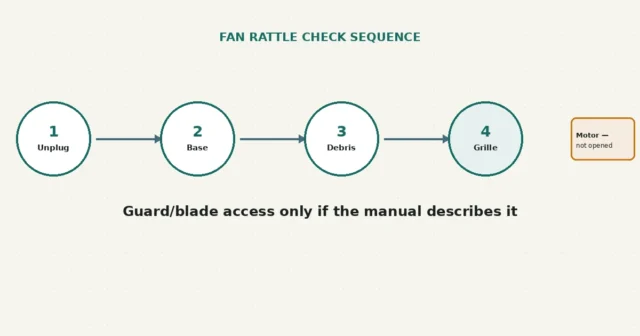
A rattle may relate to accessible dust, grille fit or base contact, but sound alone cannot identify the motor condition.…
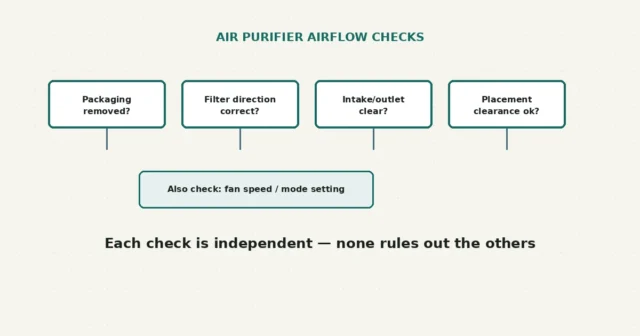
Check removable packaging, filter orientation, vent clearance and placement against the exact manual. Felt airflow does not prove filtration performance…