Dryer Takes Two Cycles: Safe Airflow Checks Before Service
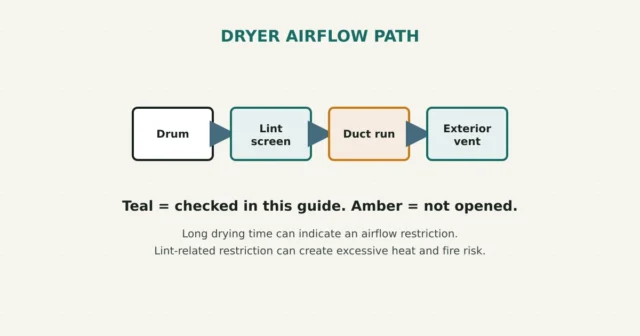
Longer drying time can indicate a blocked lint screen or exhaust path. Check the screen, load and exterior airflow, and…
White residue on dark clothing is not automatically undissolved detergent. Official manufacturer guidance lists several possibilities, including excess or non-HE detergent, lint, detergent interacting with body soil, washer buildup and water conditions. Dark fabric can simply make pale residue easier to see.
First compare the residue’s texture and where it appears. Then confirm HE compatibility, detergent concentration and dose, load size, product placement, cycle and the garment care label. For detergent clumps, rewashing on a compatible cycle without adding more detergent may help; a fibrous deposit or a film concentrated in folds may point to a different cause.
Undissolved detergent can appear as pale clumps or powder, but not every white mark has that explanation. Whirlpool also documents lint and an interaction between body soils and detergent as possible causes. The same deposit may be more noticeable against dark fabric because of contrast, but appearance alone is not enough to identify it.
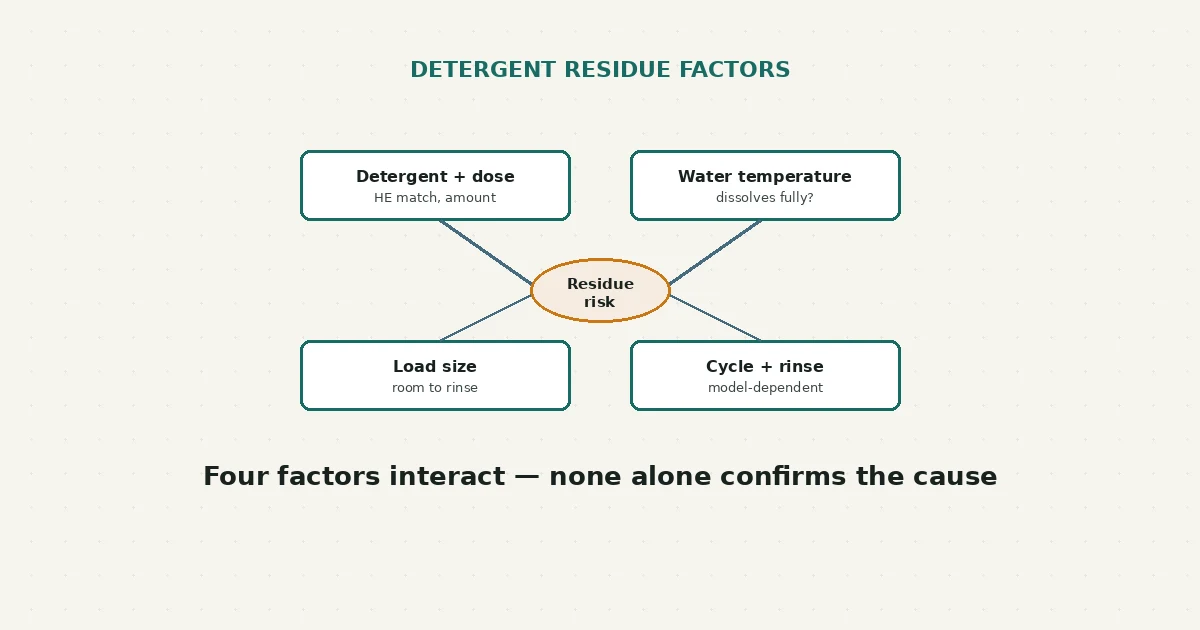
Several things affect whether detergent dissolves and rinses completely: whether the detergent is HE-labeled and matched to your washer type, how concentrated it is, how much was used relative to load size, the water temperature and hardness, where the detergent was placed in the machine, and which cycle was selected. No single one of these is “the” cause in every case — they interact, which is why the checks below work through them as a set.
It’s also worth knowing that new towels and some new clothing items can shed a related but different kind of residue — excess lint — that isn’t detergent-related at all and tends to resolve on its own after a few washes. If the residue you’re seeing looks more fibrous than powdery, it may be lint rather than detergent, and the checks below won’t necessarily change much until the new item has been through a few normal cycles.
| Observation | What it may indicate | Reasonable next step |
|---|---|---|
| Using a non-HE detergent in an HE washer | Non-HE detergents can produce more suds than an HE machine’s lower water volume can fully rinse away | Switch to a detergent labeled HE, confirmed against your washer’s manual |
| Using more detergent than the label recommends for your load size | Excess detergent is one of the most common causes of visible residue | Measure to the label’s guidance rather than estimating, and adjust down |
| Temperature-related pattern | Very cold water can leave some powdered detergent undissolved, while Whirlpool notes warmer water can worsen a separate body-soil interaction on some mixed loads | Identify the pattern first, then follow the garment label, detergent label and washer manual rather than universally raising the temperature |
| Washing a very full or tightly packed load | Less room for water to circulate and rinse detergent away fully | Reduce load size and compare results |
| Mixing fabric types (e.g., cotton with synthetics) in one load | Manufacturer guidance notes this combination can make residue more noticeable | Consider separating heavily mixed loads if residue persists |
| Detergent placed somewhere other than the product label and washer manual specify | Pacs, powders and liquids can have different placement rules, and many pacs belong in the empty drum rather than a dispenser | Use the exact placement instructions for both the washer and detergent format |
This map is meant to help narrow down contributors, not confirm a single cause. More than one factor may be involved, and temperature can point in different directions depending on whether the deposit is undissolved detergent or a soil–detergent film.
This guide covers detergent type, dosing, load size, water temperature, and cycle selection — the variables a user can adjust through the washer’s normal controls and settings. It does not cover opening the washer, bypassing sensors, altering the water supply line, or using unlabelled chemicals inside the machine. If residue persists despite working through the checks above, or if the washer shows signs of a fill, drain, or agitation problem, that’s a different issue than detergent dosing and may be worth raising with the manufacturer.
It’s primarily a visibility difference — the same amount of residue is simply easier to see against a dark background than a light one, not a sign that dark fabric attracts more residue.
Not if you’re currently using more than the label recommends — detergent is formulated to be effective at its labeled dose for a given load size and soil level, and exceeding that amount doesn’t necessarily improve cleaning.
No — this varies by model, so check your washer’s manual rather than assuming the option exists or behaves the same way across machines.
Manufacturer guidance lists home water quality as one possible factor, but appearance alone cannot prove hard water is the cause. If the basic dose, load and cycle checks do not help, ask the detergent or washer manufacturer what testing or adjustment is appropriate for your water.
Not necessarily as a first step. Confirm that the current product is correct for the washer, that its concentration and dose are understood, and that it is placed as directed. Change one factor at a time so a different brand does not hide the actual cause.
If you’re also noticing towels that don’t smell fully clean after washing, this towel odor guide covers a related set of detergent and drying observations. And if the washer itself has a musty smell that seems separate from clothing residue, this washing machine odor guide walks through gasket, dispenser, and tub checks.
New to RFSE? See how to approach any RFSE guide safely, or browse the full Laundry & Cleaning hub for more guides like this one.
This guide is based on official manufacturer documentation current as of publication. HE compatibility, dosing guidance, and available cycle options vary by washer model — always confirm details against your exact machine’s manual and your detergent’s label.
Longer drying time can indicate a blocked lint screen or exhaust path. Check the screen, load and exterior airflow, and…
A musty smell may involve trapped moisture or residue, but odor alone cannot confirm mold. Compare front-load and top-load checks…
A full bin or bag, dirty filter, blockage or poorly seated part can reduce suction. Follow the model-approved airflow checks…