Blender Leaking From the Bottom: Jar, Gasket or Blade Assembly?
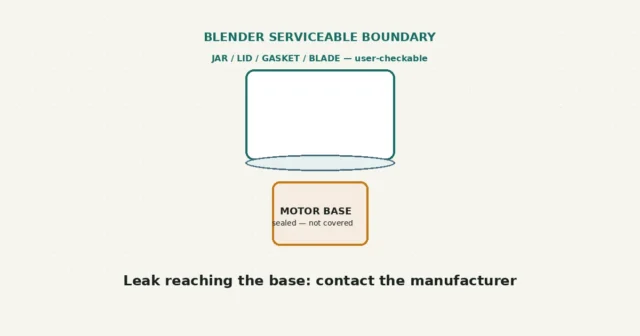
On models with removable jar parts, a gasket, collar, jar or blade assembly may be involved. Confirm the exact manual…
White, chalky deposits inside an electric kettle are almost always mineral scale from ordinary tap water — not damage. Scale is a cosmetic and performance issue that a manufacturer-approved cleaning cycle can address. It’s worth telling apart from a shorter list of genuine damage signs first, since those call for a different response.
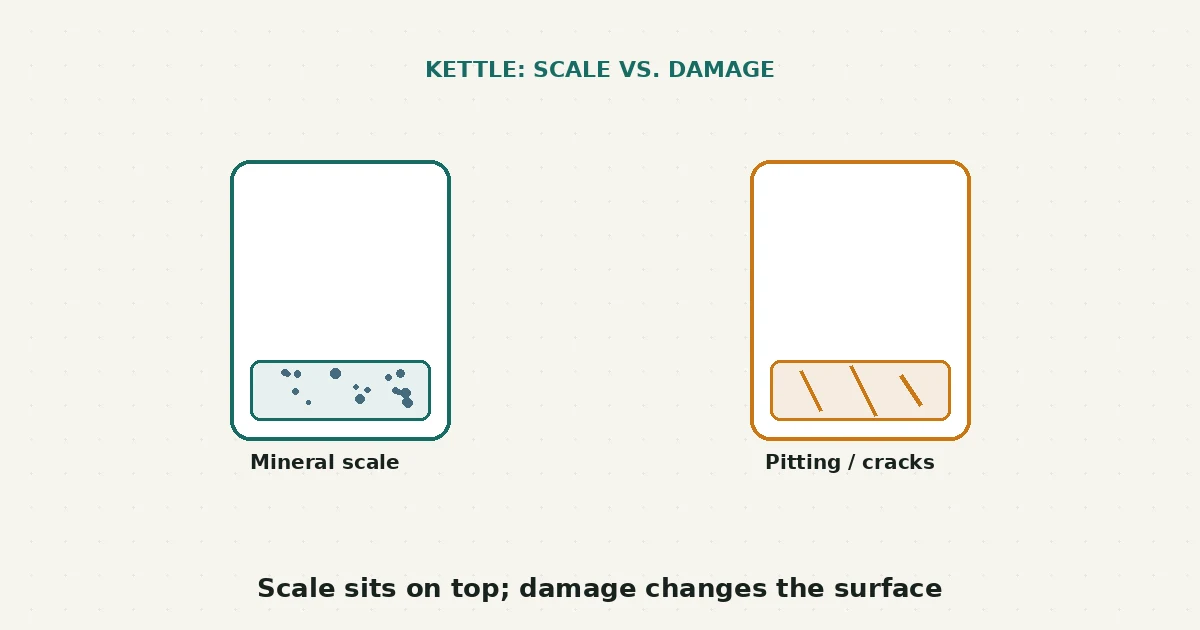
If the deposit is a dry, chalky, whitish coating on the base or heating element that comes off with soaking and gentle cleaning, it’s ordinary mineral scale. If instead you see pitting, a peeling or flaking interior coating, rust-colored corrosion, cracks, loose or rattling parts, a burning smell, arcing or sparking, cord damage, or leakage near the power connector, stop using the kettle and treat that as a different, more serious situation.
Ordinary tap water carries dissolved calcium and magnesium. Every time water is heated and evaporates as steam, a small amount of those minerals stays behind, gradually building up into the white or off-white deposit commonly called limescale. It tends to concentrate on the heating element and the base of the kettle, where water sits and heats repeatedly. This is expected wear-and-tear from heating hard water and is not, by itself, a sign that anything is broken.
Scale matters for two practical reasons: it can make the kettle take longer to boil, since minerals insulate the heating surface, and enough buildup can flake off into your cup. Neither is a safety issue on its own, but a kettle with any of the damage signs below is a different situation and this guide does not cover fixing those.
It’s worth noting that scale color can vary. In areas where the water carries more dissolved iron, the deposit may take on a brownish or grayish tint rather than pure white, which is still ordinary scale rather than a sign of damage. What distinguishes scale from a genuine problem isn’t color so much as texture and permanence — scale sits on top of the surface and can be loosened, while damage has changed the surface itself.
| Sign | Ordinary mineral scale | Possible damage — stop and check further |
|---|---|---|
| Appearance | Dry, chalky, white or off-white film or flakes | Pitted, peeling, flaking coating; rust-brown corrosion |
| Texture | Can be loosened with soaking, mild descaling, and a soft cloth | Doesn’t scrub away because it’s a change to the surface itself, not a deposit on top of it |
| Location | Base and heating element, sometimes the lower walls | Anywhere, but especially concerning around the heating element, base connector, or cord |
| Sound or smell | None specific to scale itself | Burning odor, unusual crackling, or arcing sounds |
| Kettle body | Solid, no cracks or loose parts | Cracks, looseness, or a handle or base that doesn’t sit securely |
Use this as a starting point for deciding which situation you’re in, not a certain diagnosis — if you’re unsure after comparing, treat it cautiously and stop using the kettle until you’ve checked further or contacted the manufacturer.
This guide covers identifying and cleaning ordinary mineral scale on user-accessible surfaces only. It does not cover repairing pitted or corroded heating elements, replacing a cord or base, or any internal electrical work — those situations call for contacting the manufacturer or a qualified technician, and continuing to use a kettle with the damage signs described above is not recommended.
Mineral scale itself is generally not described as a health hazard by manufacturers, but if you’re unsure whether your water supply has other issues, that’s a separate question worth directing to your local water provider.
Not necessarily — coatings and finishes differ, and some manufacturers give different guidance depending on the interior material. Check your specific model’s manual rather than assuming one method fits all.
Water hardness in your area is the biggest factor, but how often the kettle is emptied after use and how regularly it’s cleaned also play a role.
Occasional light scale particles are generally treated as a nuisance rather than a hazard, but if you’re seeing this regularly, cleaning the anti-scale filter and descaling the kettle should reduce it.
Mineral buildup isn’t unique to kettles — if a coffee maker in the same kitchen has been brewing slower than usual, this guide to coffee maker flow and descaling covers a closely related pattern. And if dishes are coming out of the dishwasher with a similar chalky film, this hard-water-versus-detergent comparison may explain what you’re seeing there too.
New to RFSE? See how to approach any RFSE guide safely, or browse the full Kitchen Equipment hub for more guides like this one.
This guide is based on official manufacturer documentation current as of publication. Descaling methods, dilution amounts, and soak times vary by model — always confirm details against your exact kettle’s manual before cleaning.
On models with removable jar parts, a gasket, collar, jar or blade assembly may be involved. Confirm the exact manual…
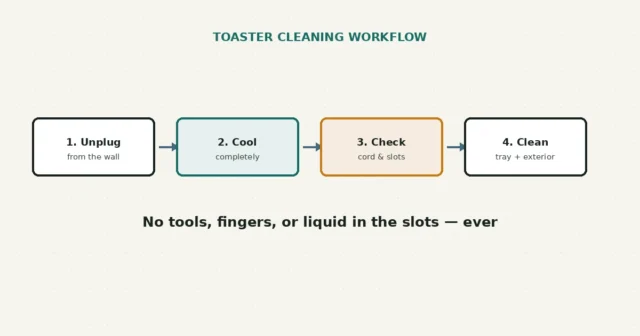
Unplug, let cool, then clean only the removable crumb tray and exterior. Crumb buildup is a documented fire risk, but…
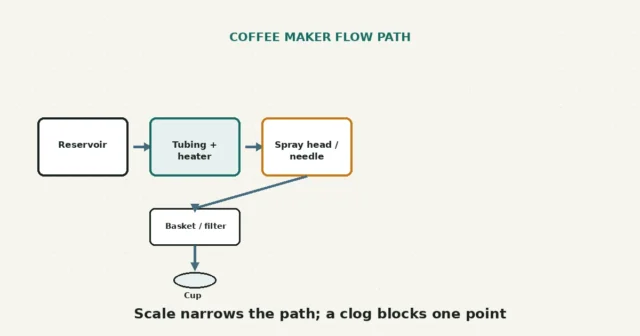
Slow brewing may trace to a removable clog or mineral scale, but cleaning cannot rule out an internal fault. Compare…